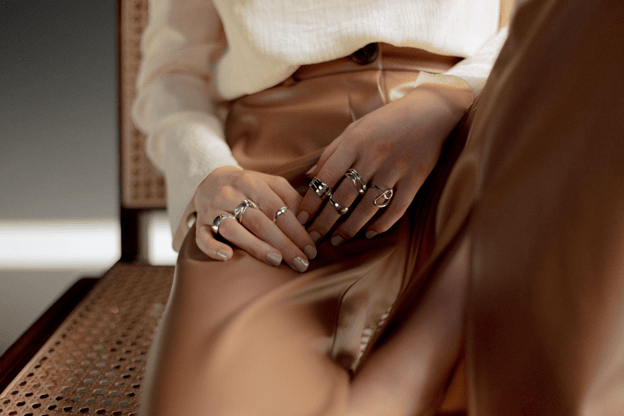
Ring stacking started as a quiet way to play with jewellery, and somewhere along the line it became one of fashion’s most personal statements. A good stack says something about you before you’ve spoken a word – your taste, your mood, the way you like things put together. Getting there isn’t just a matter of sliding a few bands onto a finger and calling it done, though. Proportion, placement, and how your metals get along all shape the outcome.
What Is Ring Stacking, and Why Has It Taken Off?
At its simplest, ring stacking is wearing more than one ring at a time, whether that’s several on a single finger or a few scattered across your hand. It’s not new. Cultures have layered rings for centuries. What changed is the spotlight, courtesy of editorial shoots and the endless scroll of style communities online.
The reason it stuck around comes down to flexibility. One collection of rings can read as quiet and refined, or loud and maximalist, depending entirely on how you arrange them that morning.
How to Choose Rings That Work Well Together
Start with proportion. You can pair a whisper-thin band with something chunky and sculptural, but it needs balance to keep from looking accidental. A reliable approach is to anchor everything with one or two mid-weight bands, then build out. Slim rings tend to support the heavier pieces instead of fighting them.
Mixing metals is far less controversial than the old rules would have you believe. Gold, silver, and rose gold sit together happily, as long as the finishes match – keep them all polished, or all matte – and the styles speak the same language, be that geometric, organic, or pared back.
Stones deserve a thought too. A ring with a larger stone pulls the eye, so placing it toward the centre of a stack with plainer bands flanking it gives you a natural focal point. This is also why versatile stacker rings earn their keep. Ones with a bit of texture, a small stone, or an unusual shape slot in beside almost anything, which makes them worth the investment.
Placement and the Proportions That Actually Flatter
Piling rings onto one finger makes a bold impression. Spreading them out lends your hand a sense of movement. Neither is wrong, but each asks something different of you.
On a single finger, odd numbers usually feel more settled than even ones. Three rings look considered in a way that two or four rarely manage. When you go multi-finger, resist the urge to crowd everything onto neighbouring fingers. A gap gives the whole hand room to breathe.
Then there’s your hand itself. Shorter fingers often look best with delicate, low-profile stacks that lengthen rather than swamp. If your fingers are on the longer side, you can carry more dramatic combinations without a second thought.
Styling Your Stack for the Occasion
For work, keep it reined in. Two or three simple bands from the same metal family come across as polished and deliberate. The textured, stone-set layers can wait until you clock off.
Evenings and events are where you loosen up. Throw in a chunky sculptural piece, or stack five or more bands on one hand – the kind of statement that photographs well and holds its own against a bold outfit.
Everyday stacking lands somewhere between the two. A handful of rings you genuinely love and barely take off, the ones that quietly become your signature.
Build Your Stack Intentionally
The best stacks aren’t bought in a single afternoon. They grow, piece by piece, with each addition chosen for how it plays against what’s already on your hand. Begin with one solid foundation ring and add slowly. Rearrange now and then, since a familiar set can look brand new in a different order.
Stacking rewards patience and a bit of experimentation. Follow your instincts, keep the combinations that feel right, and let the whole thing shift as your style does!