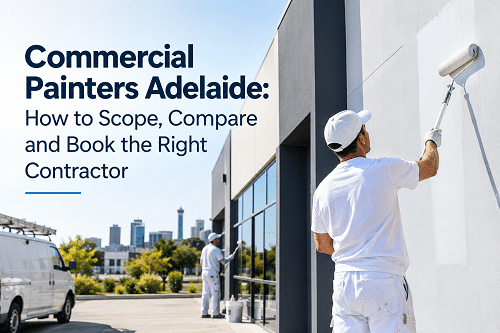
When you hire commercial painters in Adelaide, a quote is only as reliable as the scope behind it. Before you request prices, settle three things: exactly what is being painted and in what condition, when the site can be accessed, and whether the building has hazards or approvals that need clearing first. Contractors who are given the same clear brief produce quotes you can compare. Contractors given a vague one produce numbers that look similar but cover different work.
This guide explains how to prepare that brief, what drives commercial painting costs, how to plan around trading hours, and what to check before work begins.
What commercial painting covers
Commercial painting is the painting and coating of non-residential buildings: offices, shops, warehouses, schools, and the common areas of strata properties. It differs from home painting in several ways. Surfaces are larger, access may need equipment such as scaffolding or elevated work platforms, the building usually has to keep operating, and some areas need more durable products than a standard decorative paint.
Two terms are worth defining:
- Surface preparation is everything done before the first coat: cleaning, repairing cracks and damage, sanding, spot-priming or full priming. It is usually where quotes differ most.
- Protective coatings are paint systems chosen mainly to resist wear, moisture or corrosion rather than just to look good. They are common on steel, concrete floors and exposed exterior surfaces.
| Property type | What usually matters most |
| Offices and reception areas | Working around staff and fit-outs, low-disruption scheduling, durable finishes on high-touch walls and doors |
| Retail and hospitality | Trading hours, shopfront presentation, short shutdown windows, protecting stock and fixtures |
| Warehouses and factories | Ceiling and wall height, access equipment, dust and contamination, coating suitability for the surface |
| Strata common areas | Owner or committee approvals, resident notice, consistent colour matching across stages |
| Schools and education facilities | School holiday windows, durable finishes in corridors and classrooms |
For heavy steel or corrosion-prone structures, you may need industrial painters Adelaide facilities rely on for protective coatings. Our guide to industrial painting in Adelaide covers coating systems and preparation methods in more depth.
Step 1: Define the scope before you ask for quotes.
A written scope gives every contractor the same starting point. At minimum, list:
- Areas and surfaces: walls, ceilings, doors, frames, trims, floors, facades, fences, signage, steel
- Approximate sizes: floor plans or measurements if you have them, plus ceiling heights
- Current condition: peeling, flaking, water staining, mould, cracking, previous coating type if known
- Finish and colour: existing colours to match, new colours, any brand or product requirements
- Access: hours the site is available, loading and parking, lifts, security or induction requirements
- What stays in place: furniture, stock, equipment, and who is responsible for moving it
- Staging: whether the work must be done in zones so parts of the business keep operating
A site inspection will refine this, and condition issues often only appear in person. The brief is still worth writing, because it shows you which questions each contractor asked.
What affects a commercial painting quote?
Pricing depends on the building, so there is no reliable single figure for a commercial job. Online cost ranges vary widely and often hide how they were calculated. These are the factors that actually move a quote:
| Factor | Why it affects cost | What to tell the contractor |
| Surface area | Labour and materials scale with area | Plans or measurements, number of rooms or elevations |
| Surface condition | Repairs, scraping, sanding and priming add time | Known damp, flaking, previous coatings, patching needs |
| Height and access | Scaffolding, lifts or platforms add equipment and safety planning | Ceiling heights, building levels, external access constraints |
| Coating system | Protective or specialist products cost more than standard paint and may need more coats | Wear, moisture, chemical or corrosion exposure |
| Working hours | After-hours or staged work can extend the program | Trading hours and available windows |
| Site conditions | Protecting stock, fixtures and flooring takes time | What must be covered or moved |
| Approvals and hazard checks | Testing and coordination may be needed before work starts | Building age, any asbestos register, landlord or strata requirements |
If two quotes differ sharply, compare the scope, preparation and paint system before comparing the totals.
Planning around trading hours
Disruption is the issue business owners raise most. Common approaches, with their trade-offs:
| Approach | Advantages | Trade-offs |
| After hours or weekends | Minimal impact on customers and staff | Longer overall program, may cost more, needs site access and security arrangements |
| Staged work during hours | Business stays open | Needs clear zoning, noise and odour management, careful protection of customers |
| Short shutdown window | Fastest overall completion | Needs advance planning, accurate scoping and materials ready on site |
Ask each contractor how they would stage the job, and check the product data sheets for drying times and re-entry guidance for your space.
Safety, hazardous materials and approvals
These are the checks owners most often overlook.
Asbestos. Older buildings may contain asbestos-containing material. Under the Safe Work Australia model code, a person with management or control of a workplace is expected to have asbestos identified by a competent person and an asbestos register prepared and kept. Tell your contractor early if you have a register, and ask what they will do if they find suspect material mid-job. See the Safe Work Australia asbestos code of practice.
Lead paint. Older paint layers, particularly on buildings from before the 1970s, may contain lead, which becomes a hazard when sanded, scraped or heated. If the building’s age suggests lead is possible, ask how the contractor tests for it and what preparation method they would use. AS/NZS 4361.2 is the Australian guide to lead paint management.
Working at heights. Falls are a major cause of serious workplace injury. The Safe Work Australia model code on managing the risk of falls applies to workplaces covered by WHS laws, and certain high-risk construction work requires a Safe Work Method Statement. Ask contractors how they will manage height work on your building.
Licensing. In South Australia, building work contractors are licensed by Consumer and Business Services (CBS) under the Building Work Contractors Act 1995, and CBS advises checking the licence register before agreeing to building work. Check the licence name and number against the business quoting. Whether a licence applies to a specific commercial job depends on the work, so confirm with CBS if you are unsure.
Approvals. Check your lease and any strata or landlord requirements before changing colours or exteriors. If the building is heritage-listed or in a heritage area, confirm with your council or Heritage SA before any exterior colour change.
Adelaide exteriors: scheduling and product limits
Exterior work is exposed to sun, heat and seasonal weather. Coating manufacturers publish application limits (temperature, humidity, recoat times) on each product’s technical data sheet, and these limits should drive scheduling rather than the calendar alone. Ask the contractor which product they plan to use and how the timing fits its data sheet.
Comparing quotes like for like
When comparing commercial painting contractors Adelaide businesses can choose from, a comparable quote should state:
- Areas and surfaces included, and anything excluded
- Preparation steps for each surface type
- Paint brand, product name and number of coats (not just “premium paint”)
- Access equipment and who supplies it
- Working hours, staging and expected program
- How variations (extra repairs, hidden damage) will be priced and approved
- Payment terms and milestones
- Licence number and certificate of currency for insurance
- Warranty terms in writing
- Relevant project photos or references for similar work
A quote that omits preparation or product details may look cheaper because it covers less.
Common mistakes
- Comparing totals without comparing scope. The cheapest quote may skip preparation.
- Leaving access and hours until after the quote. These change labour and program.
- Skipping the hazard conversation on older buildings. Discovering asbestos or lead mid-job stops work.
- Accepting “premium paint” without a product name. Ask for the product and the data sheet.
- Not agreeing how extras are handled. Hidden repairs are normal; surprise invoices are avoidable.
- Choosing on colour sample alone. Sheen, durability and cleanability matter in commercial spaces.
How Sun Painters Adelaide approaches commercial quotes
Sun Painters Adelaide follows a professional process that begins with an on-site consultation, followed by a detailed written quote based on the inspection. Preparation includes cleaning, repairing and priming surfaces, and every project concludes with a final inspection and clean-up. Sun Painters Adelaide Pty Ltd holds South Australian building licence BLD337416, which can be checked on the CBS register.
As experienced commercial painters in Adelaide, Sun Painters Adelaide provides painting solutions for a range of commercial properties. Explore our commercial painting services in Adelaide or contact our team to arrange a site inspection and discuss your project.
FAQs
Does a commercial painter in South Australia need to be licensed? CBS licenses building work contractors under the Building Work Contractors Act 1995 and advises checking the register before agreeing to building work. Whether a licence is required for your specific job depends on the work, so confirm with CBS. You can verify any contractor’s licence number on the CBS register.
How long does a commercial repaint take? It depends on area, condition, access and whether work is staged around trading. A contractor should give you an estimated program after inspecting the site, not before.
Can painting happen while the business is open? Often yes, using staged zones or after-hours work. The right approach depends on noise, odour, access and how much of the space can be closed off.
Who is responsible for checking asbestos before painting? Under the Safe Work Australia model code, the person with management or control of the workplace is expected to ensure asbestos is identified and a register is kept. Tell your contractor if you have one, and ask what happens if suspect material is found.
How often should a commercial building be repainted? There is no fixed interval. It depends on traffic, exposure, product and maintenance. Signs it may be time include peeling, chalking, fading, staining or wear marks. Ask for an inspection-based recommendation.
