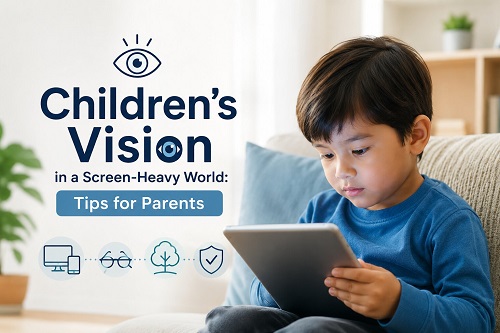
Children today are growing up alongside screens. Tablets for homework, phones for entertainment, video calls with grandparents, and classroom devices have made sustained screen exposure a near-constant feature of childhood. For many parents, the question is no longer whether their child uses screens, but how to manage that use wisely. As an Ophthalmologist Melbourne families rely on for specialist eye care, Dr Simon Skalicky has observed a clear shift in the vision concerns presenting in younger patients. The rise in childhood myopia, the increased frequency of digital eye strain, and the broader effects on developing visual systems are prompting more families to seek the guidance of an expert eye specialist earlier than ever before.
Understanding what is actually happening to children’s eyes, and what families can practically do about it, is the starting point.
The Myopia Surge: What Eye Health Professionals Are Seeing
Myopia, or short-sightedness, is increasing among children at a rate that cannot be explained by genetics alone. Environmental factors, particularly the amount of time children spend on near-focus activities, are widely considered major contributors. When the eye is repeatedly focused on objects at close range during childhood, when the eye is still growing and highly responsive to its visual environment, it can promote elongation of the eyeball. That elongation is the structural change that causes myopia.
Once myopia develops, it is permanent. Vision can be corrected with glasses or contact lenses, and progression can be managed, but the underlying change to the eye cannot be undone. Children who develop myopia also carry a higher lifetime risk of serious eye conditions including glaucoma, retinal detachment, and cataracts. For any Ophthalmologist Melbourne sees in clinic, early detection and proactive management are the central priorities.
What Screens Actually Do to Young Eyes
Screens are not inherently harmful, but the behaviour they promote, extended periods of close-up focus with minimal breaks, creates real and measurable effects on children’s eyes.
Digital eye strain is among the most common presentations an expert eye specialist encounters in younger patients. Symptoms include tired, dry, or sore eyes, headaches after screen sessions, blurred vision, and difficulty refocusing when looking from near to far. Children are often poor at identifying these symptoms as vision-related, which means issues can persist unnoticed for longer than they should.
Blink rate is another factor. When concentrating on a screen, children blink significantly less than normal. The blink reflex distributes moisture across the eye surface, and when it is suppressed, dryness and irritation follow. Blue light exposure, particularly in the hours before sleep, can also interfere with melatonin production and disrupt sleep quality, with downstream effects on concentration and health that extend well beyond eye function.
Practical Steps Parents Can Take
An expert eye specialist will typically recommend a combination of behavioural strategies tailored to a child’s age and screen habits. These steps are grounded in current evidence and can be implemented without specialist equipment or expense.
Prioritise outdoor time. Research consistently shows that children who spend at least one to two hours outdoors each day develop myopia at lower rates than those who spend most of their day indoors. Natural light exposure and the opportunity to focus on distant objects appear to support healthy eye development during critical growth periods.
Apply the 20-20-20 rule. Every 20 minutes of screen use, the child should stop and look at an object at least 6 metres away for 20 seconds. This allows the eye muscles to relax from sustained near-focus and reduces cumulative strain.
Follow age-appropriate guidelines. For children under two, recreational screen time should be avoided entirely outside of video calls. Children aged two to five should have no more than one hour of recreational screen use per day. For older children and teenagers, keeping recreational screen time to two hours or fewer daily provides a sensible boundary.
Attend to posture and distance. Screens should be held at arm’s length, and rooms should be well lit. Using devices in dark environments significantly increases visual contrast and adds to eye strain. Adjusting screen brightness to match the surrounding light level makes a practical difference.
Create screen-free zones. Bedrooms and dining areas are natural candidates. Removing screens from these spaces reduces overall exposure and supports better sleep, which has its own benefits for growing eyes and developing brains.
When to Seek Advice from an Ophthalmologist Melbourne
All children should have their eyes examined before starting primary school, and at regular intervals throughout their school years. Many developing vision problems produce no obvious symptoms, and children frequently do not report difficulties because they assume their experience of vision is normal.
Parents should arrange a visit with an expert eye specialist if a child is regularly squinting, rubbing their eyes, sitting unusually close to screens or the television, complaining of headaches during or after near-work, or if their reading or schoolwork is declining without an obvious explanation.
Where myopia has already developed, an expert eye specialist may recommend management options designed to slow its progression. Low-dose atropine eye drops, specialised myopia control spectacle lenses, and orthokeratology contact lenses worn overnight to reshape the cornea are among the approaches available. These are not cures, but they can meaningfully reduce the degree of myopia a child ultimately develops.
Protecting Vision Is a Long-Term Investment
The choices families make around screen time during childhood have consequences that extend into adulthood. Establishing healthy habits early, combined with regular monitoring by a qualified Ophthalmologist Melbourne, gives children the best chance of maintaining good vision as they grow. If you have concerns about your child’s eye health, or simply want a professional assessment, Dr Simon Skalicky consults at Cabrini Hospital Malvern and Eye Surgery Associates in East Melbourne. Visit www.drsimonskalicky.com.au to learn more or request an appointment.