Most businesses never choose their bins. They inherit them. The bin was already on site when the lease was signed, the collection schedule came with it, and nobody has looked closely at the invoice since.
That was survivable when landfill was cheap. It is not anymore. Victoria’s waste levy has climbed from around $66 a tonne in 2020 to roughly $177 a tonne for metropolitan municipal and industrial waste in 2026-27. Every tonne you send to landfill carries a state charge that has almost tripled in six years, and it sits inside your per-lift price whether the invoice itemises it or not.
The useful part is that three things drive most of your waste cost: the type of bin, its size, and how often it gets emptied. All three are straightforward to change.
Why the wrong bin quietly costs you money
Commercial waste is charged per lift, not per kilogram. If a half-empty bin gets collected twice a week, you are paying twice a week for the truck, the driver and the trip. What is inside is almost incidental.
The mistake runs in both directions.
Over-serviced sites pay for capacity they never use. A café on a 3 m³ front lift bin collected three times a week, when the volume would comfortably fit two collections, is spending about a third more than it needs to.
Under-serviced sites pay in other ways. Overflowing bins mean ad hoc pickups at casual rates, bags stacked on the ground, complaints from neighbouring tenants and a decent chance of a council notice. A lid that will not close is also a manual handling and pest problem.
Then there is contamination. One wrong load in a recycling bin can be rejected and sent to landfill instead, so you pay the landfill rate plus a contamination charge on material you thought you were recycling.
The three bin types, plainly explained
Commercial collections in Melbourne run on three lifting systems. Which one suits you comes down to volume and site access.
Rear lift bins (120L, 240L, 660L, 1100L)
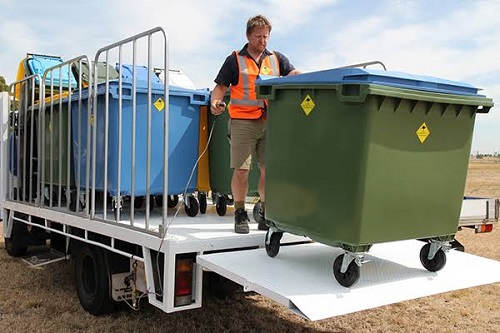
These are the wheelie bins, emptied by a rear-loading truck. The 120L and 240L sizes suit small offices, salons and consulting rooms. The 660L and 1100L sizes handle cafés, small restaurants, medical practices and strip-shop retail.
Their real advantage is access. They can be wheeled through gates, along laneways and out of basement carparks, so they work on sites a large truck cannot reach. The trade-off is cost per cubic metre, which is the highest of the three once your volume grows.
Front lift bins (1.5 m³, 3 m³, 4.5 m³)
Steel bins lifted over the cab by a front-loading truck. This is the standard setup for mid-sized commercial sites: shopping centres, supermarkets, schools, aged care homes, hospitality venues and office buildings.
Front lift bins need two things. The truck has to approach head-on with room to manoeuvre, and there must be clear overhead space, so low awnings, power lines, verandahs and carpark ceilings all rule them out. Where they fit, they are noticeably cheaper per cubic metre than a row of wheelie bins.
Hook lift bins (9 m³ to 31 m³, plus compactors)
Roll-on roll-off bins. The truck takes the whole bin away and drops an empty one in its place. These suit manufacturing, warehousing, distribution centres, large fit-outs and any site producing bulky waste or high volumes of cardboard.
Compactor units in the 25 m³ to 31 m³ range are worth costing out if your volume is consistent. Compaction squeezes far more material into each bin, which cuts the number of collections rather than the amount of waste, and collections are where the money goes. Hook lift bins do need hardstand, clearance and space for the truck to reverse in.
Quick comparison
| Rear lift | Front lift | Hook lift | |
|---|---|---|---|
| Sizes | 120L to 1100L | 1.5 m³ to 4.5 m³ | 9 m³ to 31 m³ |
| Best for | Offices, cafés, small retail | Hospitality, retail, schools, aged care | Manufacturing, warehousing, bulky waste |
| Site needs | Minimal, bins can be wheeled | Head-on truck access, overhead clearance | Hardstand and room to reverse |
| Cost per m³ | Highest | Moderate | Lowest at volume |
Sizing: the questions that actually decide it
Providers will quote off a description of your business. You will get a better answer by working through these:
How much waste do you produce by volume, not weight? Commercial pricing is mostly volumetric. Watch what the bins look like at collection for a fortnight before you decide.
How compressible is it? Cardboard, plastic film and paper crush down well, which changes the maths on compactors and baling. Food waste, glass and general rubbish do not.
What are the access limits? Overhead clearance, gate widths, truck turning circle, driveway gradient, hardstand. Access rules out more bin options than volume does.
Is your peak the same as your average? If Christmas trading fills the bins but April does not, size for April and add temporary collections for the busy weeks. Sizing for the peak means paying for it all year.
A rough test: if your bins are consistently less than two thirds full at collection, you are over-serviced. If they are overflowing, you are under-serviced. Either way the setup is worth reviewing.
Separate your streams before you upsize
Every tonne diverted from landfill avoids the levy entirely. That makes separation the fastest way to cut a waste bill, and it usually beats negotiating a lower per-lift rate.
Where the wins tend to sit:
- Hospitality and food retail: organics. Food waste is heavy and expensive to send to landfill.
- Offices and professional services: paper, cardboard and comingled recycling.
- Warehousing, manufacturing and retail: cardboard, often baled on site, collected through a hook lift bin.
Victoria has not imposed a single bin rule on every business the way the household four-bin rollout works, but businesses do carry duties under the Environment Protection Act 2017. That includes the general environmental duty and an obligation to hand industrial waste to someone permitted to receive it. A provider like Budget Waste Services will assess a site and set up the bin mix and collection schedule around what is actually being thrown out, which is usually where the savings turn up.
Before you sign or renew, check these
- Ask for lift counts and tonnages, not just a monthly total
- Find the levy line on the invoice and check it against the current state rate
- Ask for a site assessment before agreeing to any change in bin size
- Read the contract for auto-renewal, rise-and-fall and levy pass-through clauses
- Diarise a review every 12 months, because volumes change and levies rise every July
Frequently asked questions
What size commercial bin do I need? It depends on volume, compressibility and access rather than the type of business. As a starting point, small offices manage on 240L to 660L wheelie bins, cafés and restaurants usually need 1100L bins or a 1.5 m³ front lift bin, and warehouses producing bulky waste move to hook lift bins from 9 m³ up.
What is the difference between a front lift and a rear lift bin? A rear lift bin is a wheelie bin emptied by a rear-loading truck and can be moved by hand. A front lift bin is a larger steel bin lifted over the truck cab, which needs head-on access and overhead clearance but costs less per cubic metre.
Is a compactor worth it for a smaller site? Usually not. Compactors pay for themselves through fewer collections, so they need consistent, high, compressible volume. If you are collecting a hook lift bin less than once a week, a standard bin is generally the better option.
How often should commercial bins be collected? Often enough that lids close and rarely so often that bins go out under two thirds full. For most sites that means weekly to three times a week, adjusted seasonally.
Does separating waste actually reduce the bill? Yes, because the landfill levy only applies to material sent to landfill. Diverted cardboard, comingled recycling and organics avoid it, and those streams are typically cheaper to collect.
The short version
Bin type follows access. Bin size follows volume. Collection frequency follows both. Get those three right and the invoice usually drops without anyone doing anything differently on the floor.